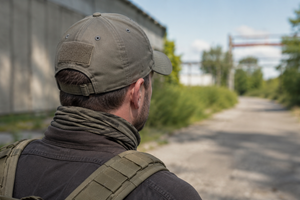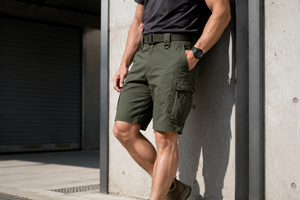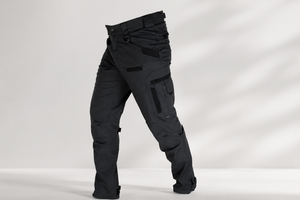

Camouflage on the battlefield is not a “cool print on a jacket”, but a matter of survival. Correctly selected coloring for specific conditions and terrain can hide movement, blur the outline, make it difficult to identify a soldier through optics. Or give away in seconds if camouflage equipment is used in a terrain other than the one it was designed for. To answer the question “which is better?”, you need to understand how each type of camouflage works and how it behaves in real combat conditions.
The main difference between multicam and pixel
In appearance, they are just two different patterns that are responsible for camouflage. However, in reality, they are These are two fundamentally different camouflage concepts created for different tasks.
Digital camo
This camouflage has a so-called digital generation design, that is, the pattern consists of small pixel fragments. Not smooth spots, as in old forms like Woodland or Flecktarn, but rather “digital torn graphics”. The concept of digital camouflage itself appeared in the 1990s – it was first implemented by the Canadian Armed Forces (CADPAT), later by the United States (MARPAT), and then by Ukraine (MM14). The idea was to break the outline of the body due to “visual noise” created by the sharp contrast of small forms. By the early 2000s, digital patterns began to be introduced en masse in NATO countries and were adapted for different theaters of combat. Pixel camouflage has the following features:
- Geometric, strictly defined shapes.
- Camouflage works well against static terrain (e.g. brickwork, ruins, city, landscape without foliage).
- Most digital camouflage (including MM14, MARPAT, CADPAT) uses a fixed palette of 3-4 clearly separated colors.
Multicam
This is a universal camouflage developed by Crye Precision to adapt to different types of terrain. Instead of pixel blocks - smooth, blurred spots that create the effect of blending with the background at different distances. The concept of multicam is based on changing color perception depending on lighting and distance. And the main goal of its creation was to get one pattern for any conditions: desert, forest, field, city, twilight. Multicam has the following features:
- Smooth transitions between shades.
- Masks both at close and long distances, especially in conditions of variable landscape.
- Multicam is built on 6-7 shades, due to which it looks more “live” and adaptive in a variable environment.

What is better, Multicam or Pixel
Camouflage is a tool. And like any tool, it can work great in one situation and much worse in another. Therefore, it is worth comparing pixel and Multicam taking into account a specific context: day or night, field, city, close or long range, movement, ambush.
-
Pixel vs Multicam in the field
A pixel at close range can look sharp, the outline of the body is readable, especially if the background is "live" (grass, bushes, branches). At medium range, pixel camouflage begins to "make noise" and this is a plus. But at a distance it risks creating a clear silhouette, especially if the pixel pattern is large.
Multicam works great in green and yellow-brown landscapes. The outline is blurred at any distance and due to smooth transitions does not catch the eye, even if the person is moving.
Multicam is better in the field.
-
Pixel vs. Multicam in urban development
Here, pixel camouflage feels most confident. Its sharp shapes "blend" into urbanism (brick, concrete, corners of buildings). It is especially effective in cloudy weather or with gray-brown architecture.
Multicam, in turn, is less effective in an urban environment. For this camouflage, the colors become “foreign” among asphalt, metal and concrete. The palette of spots looks alien against the background of rectilinear structures.
Pixel is better in urban conditions.
-
Pixel vs. Multicam in low-light conditions (night, twilight)
A small pixel pattern merges into a single-color silhouette, and against the background of vegetation it can appear spotty, but not disappearing. But the smooth gradients of Multicam “float” and level out shapes, blurring the contour better at night, especially if there is residual glow, for example, from the moon.
Multicam is better in low-light conditions.
-
Pixel vs Multicam: hiding the body contour
Pixel geometry “doesn't break” the anatomy of the body: shoulders, hips, knees remain legible, especially at close range.
Multicam's color spots blur the outlines of the figure, making the silhouette less distinguishable and harder to recognize. They seem to “break” the contours visually. Multicam is especially effective when moving on variable terrain – when moving from vegetation to open ground, through shadows, ruins, stones, etc. In such conditions, this type of camouflage prevents the silhouette from standing out sharply against each new background.
Better hides body contours in different locations of Multicam.
|
Condition |
What is more effective |
|
Field, vegetation, mixed landscape |
Multicam |
|
City, concrete, industrial zones |
Pixel |
|
Night, twilight, residual light |
Multicam |
|
Dynamics, movement between locations |
Multicam |
|
Monochrome backgrounds, flat surfaces (walls, concrete, asphalt) |
Pixel |
Based on the comparison results, Multicam really wins in many parameters, in particular where adaptability and dynamics are important in different lighting, landscape, etc. But this does not make the pixel “worse” or “outdated”, as is often attempted to be pointed out. The pixel was created for specific conditions – urban development, statics, regular army, where the logic of the pattern fits perfectly into urbanism, fortifications and low-contrast background. In its niche, it continues to work and will continue to work perfectly if used correctly.
Multicam is a universal compromise created for special forces, rapid response combat teams and tasks where it is important to be “on site” and in full combat readiness in any environment. So the verdict is simple: multicam is objectively more flexible, but both patterns are working, combat solutions. The main thing is to understand where, when and why you use them.