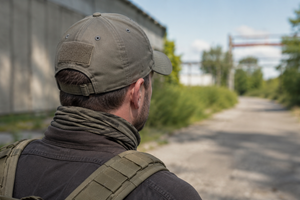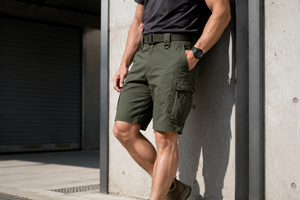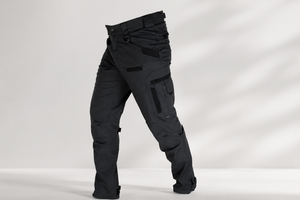

When choosing clothing for active wear, many emphasize that the material must be durable and maintain its characteristics in various weather conditions. However, something is missing from this formula. For a product not only to last long during active use but also to provide maximum comfort without restricting movement, the fabric must be able to account for constant body changes. Stepping, squatting, working on one knee, entering/exiting vehicles, sharp maneuvers – classic high-strength materials often cause significant discomfort in such conditions. It is precisely for these conditions that 4W Stretch is used in garment manufacturing.
What is 4-Way Stretch Fabric and What Materials and Fibers is it Made Of?
4-Way Stretch is a fabric capable of stretching in two directions of the web: along the warp and the weft, and returning back after the load is removed. Essentially, the material has bidirectional elasticity (unlike the equally popular 2-way version). An important point: 4-way stretch is not the name of one specific fabric. It is a property of the material achieved in different ways:
- Elastomeric fibers in the composition (most often elastane/spandex). For example, stretch fabrics based on polyamide (nylon) and elastane are a typical solution often used in tactical clothing. Why do manufacturers love the "nylon + spandex/elastane" combination so much? Because nylon gives the product strength, abrasion resistance, and durability in extreme operating conditions. And elastane (also known as spandex) adds the optimal level of elasticity and shape recovery after stretching.
- Mechanical stretch. In this case, elasticity is achieved without the use of elastomeric fibers. Using specific weaving methods or creating the necessary fabric structure through certain finishing, it is possible to obtain 4-way stretch due to the geometry of the thread interlacing and processing.
- Double weave. In tactical clothing, 4W Stretch fabric created by this method is often used. The result? For example, tactile comfort and moisture wicking on the inside, and a wear-resistant surface on the outside.
Which Synthetic 4W Stretch Fabric is Better?
One with elastomeric fibers or one produced by mechanical stretching? This question interests many, and to answer it, you just need to understand the nuances. If you need the maximum level of freedom of movement, 4-Way Stretch fabric with elastane is certainly preferable. It has a wider stretching range and recovers its shape better. In turn, 4-Way Stretch fabric created by mechanical stretching is less elastic but also less demanding in care and more durable.
If durability is your top priority, the second type wins. However, practice shows that preference is mainly given to products with elastane/spandex, because 4W Stretch is primarily about freedom of movement, and everything else comes after.
2-way and 4-way stretch – What's the Difference?
Any fabric is a grid of threads:
- warp – threads that run along the roll of fabric;
- weft – threads that run across the roll.
So, 2-way stretch stretches normally only in one direction (usually across – along the weft), and stretches very little or almost not at all along (along the warp). Meanwhile, 4-way stretch stretches both across and along – that is, along both the weft and the warp. When you need to buy clothes for maximum freedom of movement and encounter the phrase "elastic fabric," few delve into the nuances, but in this case, they are extremely important.
For Which Clothing is Synthetic 4W Stretch Fabric the Best Solution?
In short – for clothing where active movement is a routine rather than a rare exception:
- Tactical and military pants. The reason is simple and obvious: knees, stepping, running, squatting, getting into a car, frequent work in a crouched position, etc. Manufacturers who honestly specify the material usually list 4-way stretch as a key structural element for freedom of movement. For this reason, you can often see 4W Stretch fabric as the main material in tactical models.
- Winter jackets, tactical windbreakers, vests, softshell jackets. Double weave, DWR coating, and stretchability are the ideal working combination for dynamic wear during mid-season and cold weather.
- Combat shirts (UBACS). Here, 4W stretch is rarely used for the entire garment. More often, the material is used as an insert in necessary zones of the tactical shirt.
- Tactical shorts and T-shirts. When freedom of movement and quick moisture wicking are important, you should carefully study the specific density and composition of the material. But overall, 4W stretch handles this task without issues.
And of course, synthetic 4W stretch fabric is widely used in the production of gloves and sportswear.
What Characteristics Does 4W Stretch Fabric Have?
You should view the material not just from the position of "it stretches, so it's comfortable," but consider its general properties. Certainly, stretchability and recovery are the main parameters here, where it is much more important how well the fabric returns to its shape after stretching than what percentage it stretches. That is why in the production of military and tactical clothing, there are separate testing methods for elastic woven materials that evaluate their stretch and recovery properties. In simpler terms – high-quality 4-Way Stretch fabric does not turn into a "baggy knee" look after a few squats.
Tactical 4W Stretch Clothing: Advantages and Operational Features
Here are a few more important parameters of the presented material:
- wear resistance and tear resistance. The tactical version of 4W stretch is almost always built around polyamide/polyester (as the carrier base) and elastane (as the "spring"). In military and tactical lines, there are even special double weaves for the needs of specific types of clothing and gear;
- wind protection and water repellency. This is not about membrane types of fabric, but about DWR finish (coating with water- and dirt-repellent properties) and/or dense weaving, which "stops" the wind quite well;
- ventilation properties and drying speed. 4W Stretch fabric is often chosen because it does not turn into a wet rag for a long time. Due to its "breathable" properties, the material dries significantly faster than dense cotton or heavy blended twill.
The final advantage is comfort in motion. 4W stretch works perfectly in those places where regular fabric has so-called "dead zones": knees, groin area, shoulders, elbows. This is not just about 4-Way Stretch clothing being pleasant to wear. It ensures less tension on the seams and significantly reduces the risk of product tearing during sharp movements.
What Operational and Care Features Does 4-Way Stretch Fabric Have?
The following properties should not be considered disadvantages. They are simply specific behaviors of elastane under certain conditions. First, this material does not like heat and rough "express" drying. Therefore, 4W stretch with elastomeric fibers is not a fabric that should be regularly dried on a radiator. Second, which is actually the main reason for the decrease in 4-Way Stretch durability, is chlorine. Elastane and spandex begin to degrade and gradually lose their characteristics in chlorinated water (each wash cycle in water with chlorine slowly but surely destroys its structure).
4W Stretch is not some special fabric, but just another technological solution in clothing, a tool. When properly integrated into a product and followed by normal care, the material will add mobility and reduce the load on the clothing during active movement. In the case of tactical clothing, it is currently one of the most practical and versatile solutions.